25OCT

We Create what you dream and we earn what you appreciate. At MematDigi with our 360 digital and tech services we turn your ideas into impactful solutions that drive growth.

We Create what you dream and we earn what you appreciate. At MematDigi with our 360 digital and tech services we turn your ideas into impactful solutions that drive growth.
Every day, an Indian customer decides where to eat, what to buy, and which business to trust - and increasingly, that decision starts on a screen. They search Google for "best gym near me," scroll Instagram before choosing a salon, check Google Maps reviews before visiting a clinic, or message a shop on WhatsApp instead of calling. Digital marketing is how a business shows up, builds trust, and gets chosen in all of these moments.
Digital marketing is the use of online channels - search engines, social media, websites, email, ads, and messaging platforms - to reach potential customers, build relationships with them, and turn that attention into measurable business outcomes like leads, sales, or bookings. It replaces guesswork with data: every click, view, and conversion can be tracked, which means campaigns can be measured and improved over time rather than run on instinct alone.
For Indian businesses - from a Pitampura boutique to a Bengaluru SaaS startup - digital marketing has become less of an "extra" activity and more of the primary way customers discover and evaluate a business before ever walking in or picking up the phone.
Digital marketing means using online channels, platforms, data, and technology to reach audiences and achieve specific marketing or business objectives - whether that's brand awareness, website traffic, leads, or direct sales. Unlike a billboard or a newspaper ad, almost every digital marketing activity produces data: who saw it, who clicked it, and what they did next.
In plain terms, digital marketing is promoting a business using the internet instead of (or alongside) traditional media like TV, print, or radio. If a business runs a Google search ad, posts on Instagram, sends a WhatsApp offer, or optimizes its website to rank higher on Google, it is doing digital marketing.
Example: A Delhi restaurant shows up on Google Maps when someone searches "best restaurant near me," runs a short Instagram Reel campaign around a new menu, takes reservations through its website, and sends a follow-up offer to past visitors who haven't booked in a while. That combination - local search visibility, social content, a converting website, and retention marketing - is digital marketing in action.
Digital marketing, online marketing, and internet marketing are largely used interchangeably in India, though "digital marketing" is the broader umbrella term that includes all of them.
Digital marketing works less like a single tool and more like a system - a repeatable process that moves a stranger toward becoming a customer.
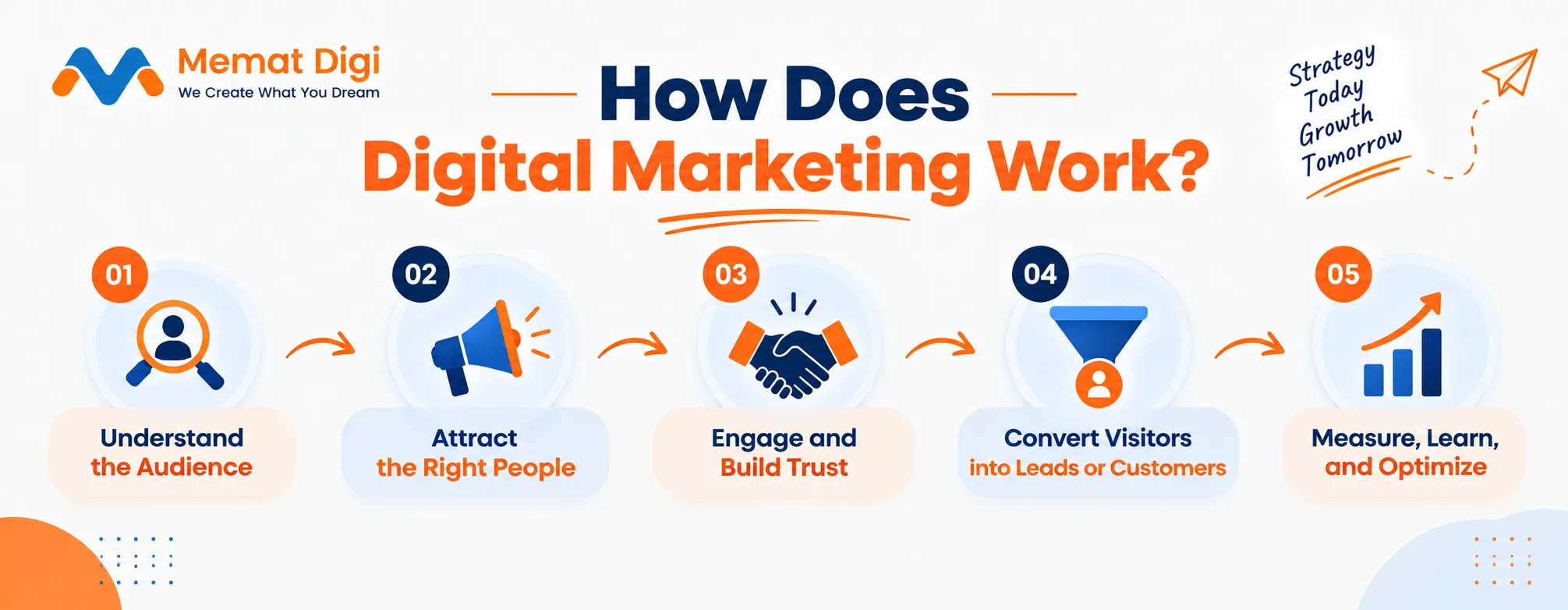
Before any campaign runs, the business needs clarity on who it's trying to reach: their needs, location, budget, and how they search or browse online.
This is where channels like SEO, paid search, and social media come in - bringing relevant people to a website, landing page, or profile.
Once someone arrives, content, reviews, case studies, and social proof help convince them the business is credible and worth their time.
Well-designed landing pages, clear calls-to-action, WhatsApp chat options, and simple forms turn interest into an actual enquiry, booking, or purchase.
Every stage is tracked - traffic, conversion rate, cost per lead, return on ad spend - so campaigns can be refined instead of run blind.
Practical example: A homebuyer searches "2BHK flats in Dwarka" on Google. They click an organic result (SEO) or an ad (PPC), land on a property page, browse a few listings, leave without enquiring, then see a retargeting ad on Instagram a day later reminding them of the property. They return, read a few reviews, and finally send a WhatsApp enquiry. The sales team follows up and closes the lead - and the entire journey, from first search to conversion, is trackable.
Digital marketing matters because it puts a business directly in front of people who are already searching, browsing, or ready to buy - and lets that business measure exactly what's working.
From Google Search and YouTube to Instagram and WhatsApp, digital platforms play an important role in how Indian consumers discover, research, compare, and communicate with businesses. Digital marketing helps brands become visible across these online touchpoints.
Campaigns can be narrowed by location, age, interest, device, or even past behavior - something traditional media generally can't match.
Impressions, clicks, leads, cost per acquisition, and revenue can all be tracked in near real time.
A local business can start with a modest monthly budget and scale spending as results justify it - unlike large fixed traditional media commitments.
A small Delhi business can rank for hyperlocal searches, while the same digital toolkit lets a growing brand expand into new cities or launch nationally.
Consistent SEO, content, and social presence compound over time, creating visibility that doesn't disappear the moment a campaign budget stops (unlike most paid advertising).
It's worth being honest here: digital marketing isn't automatically cheaper, nor does it guarantee results. Performance depends heavily on the channel chosen, competition in that industry, the strength of the offer, execution quality, and how well results are measured and acted on.
Digital marketing isn't one activity - it's a set of channels, each suited to different goals. Most effective strategies combine several of them rather than relying on just one.
SEO is the process of improving a website so it ranks higher in organic (unpaid) search results, driving ongoing organic traffic from people actively searching for related products or services. It tends to take longer to show results than paid channels, but its visibility can compound over time.
PPC is paid advertising - typically on Google - where a business pays each time someone clicks their ad. It's the fastest way to appear at the top of search results for high-intent keywords, making it useful for capturing demand that already exists.
This covers both organic posting and paid advertising on platforms like Instagram, Facebook, and LinkedIn - used for brand awareness, community building, and, increasingly, direct sales through social commerce.
Content marketing means creating useful blog posts, guides, videos, or resources that answer real questions a target audience has - building trust and organic visibility over time rather than through direct advertising.
Email marketing can be a highly efficient retention and nurturing channel when a business has a relevant, permission-based audience.
For many Indian businesses, WhatsApp can play an important role in the customer journey - from lead follow-up and product catalogue sharing to order updates and direct customer conversations.
A simpler, more direct channel than email, SMS is still used for time-sensitive offers, order confirmations, and appointment reminders - though its role has narrowed as WhatsApp and app notifications have grown.
Video has become an important discovery and engagement format across platforms such as YouTube, Instagram and other visual-first channels.
ORM involves actively managing a business's reviews, ratings, and online mentions - since most customers now check Google reviews or social proof before making a decision.
Attracting traffic is only half the job. CRO focuses on improving a website or landing page so a higher percentage of visitors actually convert into leads or customers - often through better page design, clearer offers, or faster load times.
This is a combination of SEO, paid ads, email, and CRO specifically tailored to online stores - covering everything from product discovery to cart abandonment recovery.
AI is increasingly used for audience analysis, content ideation, ad optimization, chatbots, and personalization at scale. It's best understood as a way to accelerate execution - not a replacement for strategy or human judgment, both of which still determine whether a campaign actually works.
Neither approach is universally "better" - the right mix depends on the audience, industry, and business model. But the two differ in a few consistent ways:
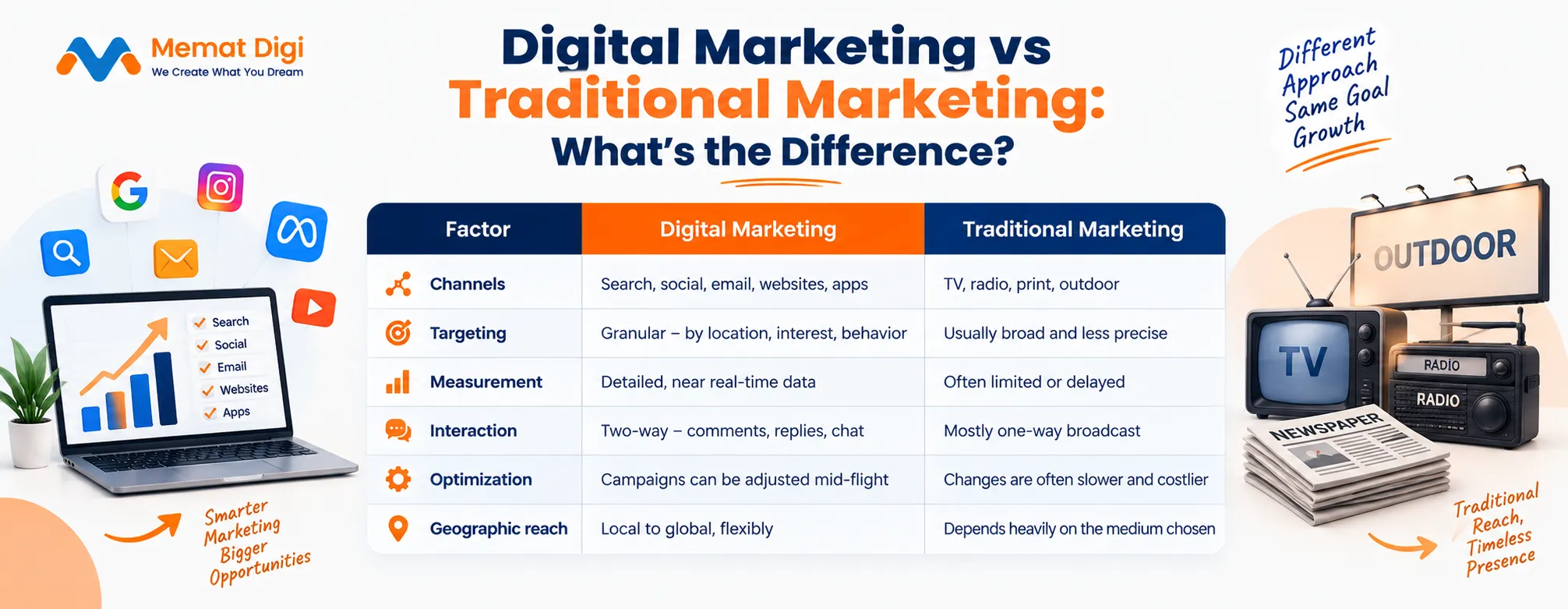
Many established businesses in India still use a mix of both - for instance, a hospital might run local TV or print alongside Google Ads and SEO, depending on the audience it's trying to reach.
Building a strategy doesn't need to be complicated, but it should follow a logical order rather than jumping straight into "which platform should we use."
Is the objective brand awareness, website traffic, leads, direct sales, or app downloads? Each goal points toward different channels and metrics.
Who are they, where do they spend time online, and what stage of the buying journey are they typically in?
Not every business needs every channel. A Delhi B2B services company might prioritize Google Search, SEO, and LinkedIn, while an Indian D2C fashion brand may lean more heavily on Instagram, creator partnerships, Shopping ads, and retention marketing.
This includes website copy, ad creative, blog content, and anything the audience will actually see and respond to.
Allocate spend based on expected return per channel, not just what competitors are doing.
Track performance against the original goals and adjust - pausing what isn't working and scaling what is.
There's no single fixed price for digital marketing - cost depends on business objectives, the channels chosen, competition in that industry, target geography, ad spend, content requirements, and whether the work is done via an agency, an in-house team, or a freelancer. A hyperlocal service business and a national ecommerce brand will have very different budgets, even within the same city.
The budget isn't just about how much to spend - it's about how to allocate what's available. That allocation should be based on business goals, the economics of each channel (what it typically costs to acquire a customer there), current organic visibility, and the balance between quick wins (like PPC) and long-term compounding growth (like SEO and content).
Each model has trade-offs, and the right choice depends on budget, the range of skills needed, and how much oversight the business wants to provide.
An in-house team offers close alignment with the business but usually costs more to build across multiple specializations (SEO, ads, content, design). A freelancer can be cost-effective for a narrow, well-defined task but may struggle to cover a full multi-channel strategy alone. An agency typically brings a broader team and cross-channel experience under one roof, which tends to suit businesses that want several channels running together without hiring for each one individually.
There's no universally "right" answer - a growing business often starts with a freelancer or agency and builds an in-house team as its needs and budget grow.
Timelines vary significantly by channel, so it helps to set expectations per channel rather than for "digital marketing" as a whole.
PPC can generate visibility almost immediately, though meaningful optimization takes time as data accumulates. SEO is typically a longer-term investment - visibility usually builds over months rather than days, but it compounds and doesn't disappear the moment spending stops. Social media and content depend heavily on consistency, audience size, and distribution. Email and retention marketing depend on the size and quality of an existing database. No channel can responsibly guarantee a fixed ranking or result by a specific date.
The right KPIs depend on the business objective - a lead-generation business and an ecommerce store won't track the same numbers. Common metrics worth monitoring include:
Organic traffic
Qualified leads
Conversion rate
Cost per lead / cost per acquisition
Return on ad spend (ROAS)
Customer acquisition cost (CAC)
Revenue attributable to marketing
Engagement, where relevant to the goal
In campaign reporting, we prioritize metrics tied to business outcomes - such as qualified leads, conversions, acquisition cost and revenue - over isolated vanity metrics such as impressions or follower growth.
B2B marketing typically deals with longer buying cycles, multiple decision-makers, and a need for lead nurturing, authority-building content, and trust signals like case studies. B2C marketing often involves shorter decision journeys, more emotional or product-led appeal, and broader opportunities through social media and ecommerce channels. The channel mix, content style, and even the KPIs used to judge success typically differ between the two.
While the underlying principles stay the same, the priorities shift by industry.
Trust, accurate information, local discoverability (Google Maps, local SEO), and responsible, compliant communication matter more here than in most other industries.
Local and high-intent search traffic, strong property content, lead qualification, and remarketing to browsers who don't enquire on their first visit all play a major role.
Search demand around courses and admissions, educational content, webinars or demo sessions, and structured lead nurturing tend to drive results.
Paid acquisition, organic product discovery, conversion rate optimization, and retention marketing (email, WhatsApp, remarketing) work together to keep acquisition costs sustainable.
Trust and education are central, alongside compliance-aware messaging and campaigns built around high-intent search terms.
Demand generation, product-led content, SEO, and lifecycle email nurturing typically matter more than broad brand advertising.
From our experience working with businesses on digital campaigns, spreading a limited budget across too many channels often makes it harder to generate enough data or momentum on any one channel. For smaller businesses, we generally recommend prioritizing the channels closest to customer intent before expanding the mix.
Example: A local service business - say, a home-repair company - is often better served by focusing on Google Business Profile optimization, local SEO, and a modest search ads budget, plus WhatsApp for fast lead follow-up, rather than trying to run six platforms simultaneously with limited resources.
For businesses that serve a specific city or neighborhood, local digital marketing can be more relevant than broad national targeting because it aligns campaigns with the locations and search terms their nearby customers actually use.
A few patterns show up repeatedly in underperforming campaigns:
Trying every channel at once instead of prioritizing what fits the audience and budget
Focusing on traffic volume instead of business outcomes like leads or revenue
Weak or missing conversion tracking, making it impossible to know what's actually working
No clearly defined target audience
Sending paid traffic to a weak or slow-loading landing page
Inconsistent content or posting schedules
Ignoring retention and repeat-customer marketing in favor of constant new acquisition
Expecting SEO results within weeks rather than months
Publishing AI-generated content without expert review or fact-checking
Digital marketing in India continues to evolve quickly, and a few shifts are worth watching.
AI tools are increasingly used to speed up research, content creation, ad optimization, and campaign analysis - reducing the manual workload without replacing strategic decision-making.
AI-generated answers and conversational search interfaces are changing how people discover information, which means visibility now extends beyond traditional search rankings alone.
As third-party tracking becomes more restricted, businesses are increasingly relying on their own customer data - email lists, WhatsApp contacts, CRM data - to power targeting and retention.
Short-form video continues to grow as a discovery channel, particularly for younger and mobile-first audiences.
Data and automation are making it easier to tailor messaging to individual customer behavior rather than broad audience segments.
As AI accelerates execution, businesses can differentiate themselves through genuine expertise, accurate information, original experience, brand understanding and strategic judgment - areas where human oversight remains critical.
Before investing further, it's worth running a quick, honest audit:
Are the right people actually finding the business online?
Which channels are generating qualified leads or revenue - not just traffic?
Are visitors converting once they arrive?
Can conversions be clearly attributed to specific channels or campaigns?
Based on that data, what should be scaled, fixed, or stopped?
Most businesses find at least one channel quietly underperforming once they look closely at conversion data rather than surface-level traffic numbers.
To see how these channels work together rather than in isolation, consider this illustrative scenario for a local Delhi home-interiors business:
A potential customer searches Google for "interior designers near me" and finds the business through a mix of local SEO and Google Maps visibility. They visit the website, browse a few project photos, but leave without enquiring. A day later, they see a retargeting ad on Instagram featuring a similar completed project. They click back, read a few Google reviews for reassurance, and this time send a WhatsApp enquiry directly from the website. The sales team follows up, and the lead is tracked from that very first Google search all the way through to a signed project - with each channel (SEO, remarketing, reviews, WhatsApp) playing a distinct role in getting the customer from discovery to decision.
A. Digital marketing is promoting a business using online channels - like Google, social media, email, and WhatsApp - instead of, or alongside, traditional media like TV or print, with the added ability to track and measure results.
A. The main types include SEO, PPC, social media marketing, content marketing, email marketing, WhatsApp marketing, SMS marketing, video marketing, online reputation management, conversion rate optimization, and ecommerce marketing.
A. It works as a system: understanding the audience, attracting the right people, building trust through content and social proof, converting visitors into leads or customers, and continuously measuring and optimizing performance.
A. It lets businesses reach customers where they already spend time, target specific audiences precisely, measure performance in real time, and scale spending according to budget and results.
A. Digital marketing offers more precise targeting, real-time measurement, and two-way interaction, while traditional marketing (TV, print, radio) typically reaches broader audiences with less granular tracking. Many businesses use a mix of both.
A. Yes - small businesses can start with a modest budget on a few well-chosen channels (like local SEO and WhatsApp) rather than trying to compete across every platform at once.
A. Costs vary widely based on goals, channels, competition, and geography - there's no single fixed price across businesses or industries.
A. It depends on the channel: PPC can show visibility quickly, while SEO, content, and social media typically build results over a longer period.
A. Expect continued growth in AI-assisted marketing, conversational and AI-driven search, first-party data usage, short-form video, and deeper personalization - with human expertise remaining central to what actually works.
Digital marketing isn't about being present on every platform - it's about understanding the customer journey, choosing the channels that actually fit the audience and budget, creating genuinely useful experiences, and measuring outcomes closely enough to keep improving. At Memat Digi, we focus on bringing these channels together into a connected strategy built around measurable business growth.
If you're figuring out where to start or how to prioritize your channels, our Digital Marketing Services page breaks down how each of these pieces - SEO, PPC, social, content, and more - comes together for businesses in Delhi NCR and across India.
Be the first to share your thoughts.
© 2026 All rights reserved MematDigi Pvt. Ltd.


0 Comments